
Helix Computing™ Platform Technical Architecture
Helix Computing™ uses Xeal Protocol, a distributed ledger based, store and forward control and messaging system designed for environments where end devices cannot rely on continuous network connectivity and server availability.

What the Platform Enables (System Behavior)
Xeal enables devices to operate reliably without continuous connectivity or real-time access to backend systems.
Deterministic device operation
Devices can execute commands, process payments or authorizations, apply configuration changes, and generate auditable records entirely offline. This works consistently across payment terminals, appliances, EV chargers, building systems, healthcare devices, and industrial equipment.
Bidirectional messaging without always-on connectivity
Xeal supports two-way communication between cloud systems and offline devices using a store-and-forward model. Data can move from backend to device, device to backend, or through mobile applications acting as temporary bridges, allowing cloud systems to remain authoritative without becoming a bottleneck.
Resilience during outages
Systems continue operating when cloud services, vendor backends, or network connections are unavailable. Critical workflows do not depend on server round trips, ensuring uninterrupted performance even in degraded conditions.
Seamless protocol continuity
When connectivity is available, devices use existing vendor protocols. During outages, Xeal automatically shifts to its own protocol layer without disrupting device behavior or user workflows, maintaining a consistent experience across both online and offline environments.

Core Architectural Pattern
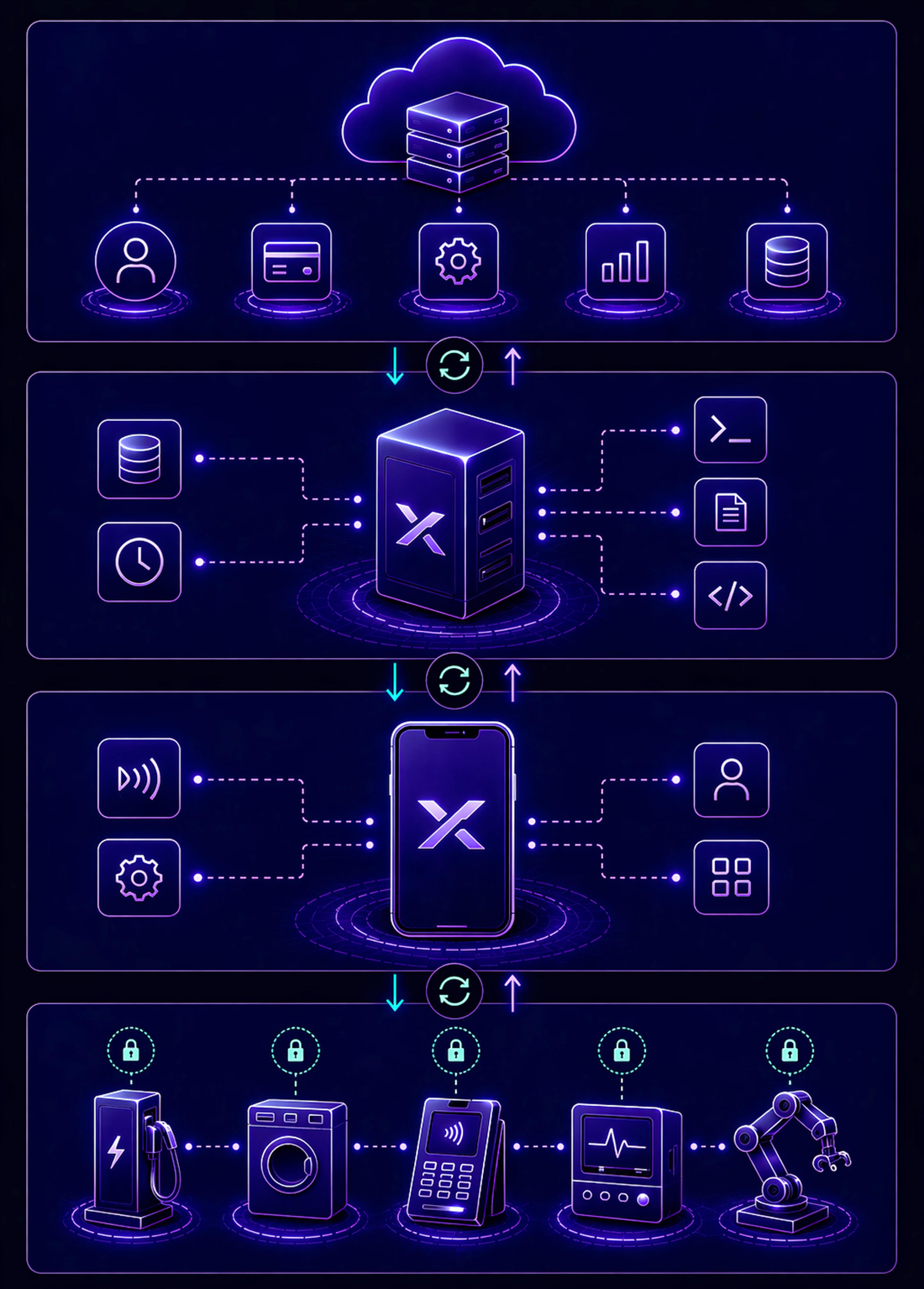
Xeal follows a consistent, layered architecture that extends backend systems into offline environments without replacing them.
Backend systems remain authoritative
Customer backends continue to manage identity, payments, configuration, and analytics. Xeal extends their reach into disconnected environments, enabling operations to continue even when backend systems are unavailable.
Xeal backend coordinates offline execution
The Xeal backend mirrors essential state for offline use, stages commands, ingests deferred logs, and exposes APIs for devices and applications. It is designed for eventual consistency rather than real-time control.
Mobile apps act as transient infrastructure
Applications with the Xeal SDK function as transport, execution, and control layers. They securely relay data, enforce logic when offline, and allow users or operators to interact with systems locally across use cases like EV charging, laundry, POS, and healthcare.
Devices execute locally
Devices run a local execution environment, accepting commands, enforcing authorization, executing actions, and logging results independently. When connectivity is available, they operate with both Xeal and native protocols in parallel.
Store and Forward Messaging Model
Xeal uses a distributed store-and-forward architecture to ensure reliable communication and execution without requiring continuous connectivity.
Store-and-forward messaging
Instead of relying on persistent connections, Xeal stages and delivers messages across a structured lifecycle. Backend systems generate intent such as updates or authorizations, which are securely staged in the Xeal backend. Mobile devices retrieve these messages when connected, deliver them locally to devices over Bluetooth or Wi-Fi Direct, and enable execution without backend access. Results are logged on-device and synced back once connectivity returns. This approach prevents lost commands, partial execution, duplicate actions, and reliance on constant server availability.
Dual online and offline execution paths
Xeal supports both standard online communication and offline operation. When connected, devices use native vendor protocols and full backend functionality. When offline, Xeal seamlessly shifts to its own protocol, using mobile devices as transport layers for local execution, logging, and later reconciliation. No manual failover or configuration is required.
Distributed execution during outages
For workflows that require decision-making, Xeal enables mobile devices to temporarily take on backend responsibilities. Phones can evaluate policies, validate requests, enforce rules, and apply constraints, allowing systems to continue operating even during full backend outages.
Protocol interoperability
Xeal integrates with existing systems without requiring replacement. It works alongside protocols like OCPP, IoT management frameworks, payment APIs, appliance systems, and industry-specific standards, adding a resilient availability layer that ensures consistent operation across both connected and disconnected environments.
Summary for Engineers
At a systems level, the Xeal Platform is:
- A distributed store and forward messaging system
- Using mobile devices as transient transport and execution nodes
- Enabling local device execution with eventual consistency
- Supporting dual protocol paths for online and offline operation
- Capable of temporary server substitution during outages
This architecture allows connected systems to behave predictably in the real world, where networks and backends are not always available.
